


In Rocklin, pools run hard from April through October under relentless Sacramento Valley heat. That constant use puts real stress on buried plumbing lines, joints, and fittings. When water levels drop, flow slows down, or your pump loses prime, the problem often sits underground.
Cool Pools provides pool plumbing repair in Rocklin for leaks, broken lines, failing joints, and low-flow problems. Most diagnoses are scheduled within the same week, and most repairs are completed in a single visit. With over 23 years of hands-on experience, we build every repair on accurate diagnosis and lasting fixes so your pool stays running the way it should.
A pool plumbing leak occurs when joints, fittings, or buried lines crack or separate underground. Rocklin’s expansive clay soil shifts during dry summers and pushes against buried PVC, making joint failures common in older systems. Early detection saves water and prevents structural damage to your pool shell.
Signs of a pool plumbing leak include:
A dropping water level does not always mean a leak. Rocklin’s dry summers push daytime temperatures past 105 degrees, and that heat pulls water out of every pool through evaporation. A quarter inch of water loss per day is normal during peak summer months. Anything beyond that deserves a closer look.
The simplest way to tell the difference is a bucket test. Fill a bucket to the top and set it on your pool step. Mark the water line inside the bucket and on the pool wall. Wait 24 hours. If the pool water dropped more than the bucket water, you are likely dealing with a plumbing leak rather than evaporation.
Other signs that point to a plumbing problem:
These warning signs often show up slowly. A small joint separation underground can leak for weeks before the water loss becomes obvious. The longer it goes, the more water you lose and the more pressure your pump works against.
If your pool is losing water faster than your neighbors’ pools and a bucket test confirms the difference, the next step is a professional pressure test to find the exact location of the break.
One of the biggest concerns homeowners in Whitney Oaks and Stanford Ranch share is the fear of tearing up their backyard to reach a broken pipe. Stamped concrete, pavers, mature landscaping, and built-in outdoor kitchens make the thought of trenching feel overwhelming. The good news is that most underground pool plumbing repairs no longer require it.
Modern no-dig repair methods allow us to access buried lines through small entry points near the equipment pad or at the pool shell wall penetration. We isolate the damaged section, make the repair, and pressure test the line before closing up. Your deck, landscaping, and hardscape stay intact.
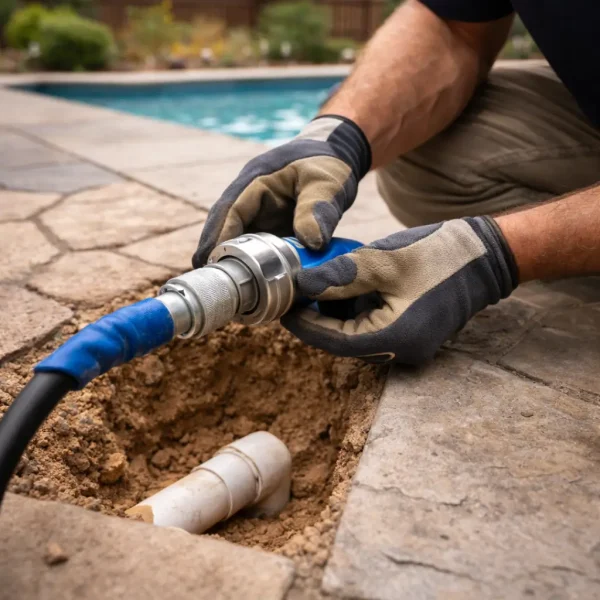
This matters especially in Rocklin, where many pools sit on compacted granite subsoil. Traditional trenching through granite is slow, expensive, and hard on the surrounding property. It often means jackhammering through concrete and then paying to replace it after the repair is done. No-dig methods skip that entire process.
Here is what a typical no-dig repair looks like from start to finish:
Not every situation qualifies for trenchless access. Long runs with multiple failure points or pipes that have collapsed completely may need partial excavation. We will always tell you what the repair requires before any work begins so there are no surprises on your property or your bill.
Replacing a broken pool line with the wrong material is a fast path to another repair call. Pipe selection matters, and Rocklin’s climate makes it matter more than most places.
Schedule 40 PVC is the standard for pool plumbing. It handles the water pressure that pumps generate during normal circulation and holds up well in direct burial applications. Most pools built in Rocklin over the last 30 years use schedule 40 PVC for their main suction and return lines.
Flexible PVC serves a different role. It works best in short runs near the equipment pad where rigid pipe would need multiple elbows and fittings to make tight turns. Fewer fittings means fewer potential leak points. Flexible PVC also absorbs minor ground movement better than a rigid joint can.
The reason material choice matters so much here comes down to temperature. Rocklin winters can dip near freezing in January. Summers regularly push past 105 degrees. That swing puts stress on every glued joint in the system. Rigid PVC expands and contracts with temperature changes, and over 20 or 25 years, that repeated movement can crack fittings or break the bond at glue joints.
Choosing the right pipe for each section of the plumbing run accounts for thermal expansion, soil pressure, and water flow requirements. The University of California Division of Agriculture and Natural Resources publishes research on soil behavior and climate effects on buried infrastructure across the Central Valley that supports what we see in the field every week.
When we replace a section of pool plumbing, we match the material to the job. Main runs get schedule 40 PVC. Tight equipment pad connections get flexible PVC. Every joint is primed, glued, and pressure tested before we consider the repair complete.
Guessing where a pool plumbing leak is hiding wastes time and money. A pressure test removes the guesswork entirely.
We test each plumbing line one at a time. The process starts by isolating a single line, whether it is a suction line, return line, or main drain line. We cap the line, pressurize it with air, and watch the gauge. A line that holds pressure is sound. A line that drops pressure has a break somewhere along its run.
By testing each line individually, we know exactly which run has failed before we ever touch a shovel or open an access point. That precision keeps the repair focused on the actual problem and protects the rest of your plumbing and property from unnecessary work.
Homes in Sunset West and some of Rocklin’s older subdivisions often have plumbing systems that are 20 years old or more. PVC joints installed in the early 2000s or late 1990s have been through decades of soil movement, temperature cycling, and constant water pressure. Hidden joint failures are common in these systems, and they rarely show obvious surface signs until the leak has been active for a while.
A pressure test catches those failures early. It also gives you a clear picture of your entire plumbing system’s condition, not just the one line causing today’s problem. If a second line is showing early signs of pressure loss, you know about it now instead of six months from now when it becomes its own emergency.
What a pressure test tells you that a visual inspection cannot:
Every pool plumbing repair we perform in Rocklin begins with a pressure test. It is the fastest, most accurate way to protect your property and your budget.
When a single pool plumbing line has multiple small cracks along its run, replacing each one individually is not always the best approach. Trenchless epoxy relining offers a way to restore the full interior of the pipe without digging it up.
The process works by pulling an epoxy-saturated liner through the inside of the existing pipe. The liner coats the full interior wall, sealing cracks, joint separations, and small fractures in one pass. Once the epoxy cures, the pipe has a smooth new interior surface that is fully sealed and ready to handle normal pool system pressure.
Rocklin’s soil conditions are a big reason this method works so well here. The mix of clay and decomposed granite beneath most Rocklin properties creates ground movement that shifts with moisture levels and temperature changes. That movement pushes against buried PVC and tends to crack pipes right at the fittings where two pieces join. A standard spot repair fixes one fitting, but if the soil has stressed the entire run, the next fitting in line often fails within a year or two.
Relining addresses the full length of the pipe at once. Instead of chasing one crack after another over multiple service calls, the entire run gets sealed in a single visit.
Relining works well when:
Relining is not the right fit for every situation. Pipes that have collapsed, separated completely, or lost their round shape may need full replacement of that section. We determine which approach fits your system after pressure testing and inspecting the line condition. You will know exactly what the repair involves and why before we start any work.
Most pool plumbing failures do not happen overnight. They build slowly over months or years as small problems go unnoticed. A few simple checkpoints in fall and spring can catch those problems early and keep your system running without emergency calls.
Fall is the critical window in Rocklin. Oak trees drop heavy loads of leaves and acorns starting in late September, and neighborhoods like Park Drive and Whitney Ranch see it the worst. That debris fills skimmer baskets fast. When baskets overflow, leaves and sediment get pulled into the skimmer line and pack against bends and fittings. A clogged skimmer line restricts flow, forces the pump to work harder, and builds pressure in sections of pipe that were never designed to handle it.
Clearing skimmer baskets weekly during leaf season and flushing the skimmer line before winter takes five minutes and prevents the kind of pressure buildup that cracks fittings underground.
Spring brings its own checklist. Before the pool runs full time again, a visual inspection of exposed plumbing at the equipment pad can reveal small drips at unions, valves, or pump connections that developed over winter. Catching a weeping fitting above ground is a quick fix. Ignoring it lets the problem grow into a bigger repair once the system runs eight or ten hours a day through summer.
A solid seasonal routine looks like this. In fall, flush all skimmer lines, inspect valve handles for stiffness or cracking, and confirm the main drain pulls evenly. In spring, check every visible fitting for moisture, run a short pump cycle to watch for air bubbles in the returns, and verify that water flow through each return jet feels even and strong.
These small steps add years to the life of your pool plumbing. When something does need attention, catching it during a routine check means a scheduled repair instead of a weekend emergency.
Yes, underground pool pipes in Rocklin can be fixed without digging up your backyard in most cases. We use trenchless repair methods and epoxy relining to access and restore buried lines through small entry points near the equipment pad or pool wall. Your deck, pavers, and landscaping stay in place. If a section of pipe has fully collapsed or separated, partial excavation may be needed, but we confirm that with you before any work begins.
Schedule 40 PVC works best for pool plumbing in Rocklin’s climate because it handles standard pool pressure and holds up well through the area’s temperature swings from near freezing in winter to over 105 degrees in summer. Flexible PVC is a better choice for short, tight runs near the equipment pad where fewer fittings mean fewer potential leak points.
Underground pool pipes typically last 25 to 30 years before they need repair. In Rocklin, soil movement from clay and decomposed granite and root intrusion from mature trees can shorten that timeline. Homes with plumbing systems older than 20 years benefit from a pressure test to check the condition of each line before a small problem turns into a larger failure.
Properly balanced chlorine will not damage your pool’s PVC pipes. The material is designed to handle normal sanitizer levels used in residential and commercial pools. However, consistently high chlorine concentrations over several years can weaken the glue joints and fittings that connect pipe sections together, which is why routine water testing and chemical balancing matter for long-term plumbing health.
Commercial Pool Maintenance
Pool Filter Repair
Swimming Pool Inspection
Pool Pump Replacement
Swimming Pool Heater Repair
Pump Repairs & Installation
Pool Motor Repair
Swimming Pool Electrical Repair
Pool Automation System Repair
Pool Light Repair
Swimming Pool Auto Water Fill Repair
Heat Pump Repair
Pool System Diagnostics
Swimming Pool Equipment Repair
Saltwater System Repair
Serving: Rocklin · Roseville · Lincoln · Granite Bay · Loomis · Penryn · Newcastle · Auburn · Citrus Heights · Folsom · Orangevale · Fair Oaks · Carmichael
Schedule your Rocklin pool plumbing repair before a small crack becomes a costly break.