


In Rocklin, saltwater pools face heavy demand from long summers and extreme heat that push salt cells to their limits. When your system stops producing chlorine, water quality drops fast. This page covers the most common saltwater failures we see across Rocklin, including failing salt cells, faulty chlorinators, control board errors, and low chlorine output.
We offer diagnostic appointments within the week, and most repairs are completed the same day. As a swimming pool repair service built on over 23 years of hands-on work, Cool Pools focuses on restoring your saltwater system to full production so you can get back to enjoying your pool.
A saltwater system stops working when the salt cell, control board, or flow sensor fails to generate or deliver chlorine. In Rocklin, hard water and high calcium levels accelerate scale deposits on cell plates. Diagnosing the correct component prevents unnecessary part replacement.
Your saltwater system has one job: turn salt into chlorine to keep your pool clean. When that process breaks down, your water loses its only line of defense. Cloudy water, rising combined chlorine levels, or a “low salt” warning on your control panel are all signs that something has failed.
The tricky part is that your salt level may test perfectly fine. The problem is usually inside the system itself. A worn-out salt cell, a faulty control board, or a blocked flow sensor can all shut down chlorine production while your display shows normal salt readings.
In Rocklin, this becomes urgent faster than in cooler climates. Summer temperatures above 100 degrees burn off free chlorine at a much higher rate. A pool that would stay balanced for days in mild weather can turn green in as little as 48 hours when the system stops producing. The longer you wait to diagnose the issue, the more likely you are facing an algae bloom that requires a full shock treatment and extended recovery time.
If your pool looks hazy or your test strips show low free chlorine despite correct salt levels, the system needs professional attention before the problem grows.
Not every saltwater system failure means you need a new salt cell. Homeowners in Whitney Oaks and Stanford Ranch often call us assuming the cell is dead, but the real issue turns out to be the control board or a simple sensor problem. Knowing the difference saves you money and gets your pool back online faster.
A failing salt cell usually shows gradual signs. Chlorine output drops over weeks or months. You may notice the pool needs more and more manual chlorine to stay clear. When you pull the cell out and look at the plates, you might see heavy white scaling or plates that look thin and worn. The system may still power on and appear to run normally, but chlorine production keeps falling.
A control board failure looks different. The display may flash error codes, go blank, or fail to power on entirely. In some cases the board sends incorrect voltage to the cell, which means the cell never receives the signal to start producing. The cell itself could be in perfect condition, but nothing happens because the brain of the system is not working.
A flow sensor issue is the easiest to miss. The sensor tells the system that water is moving through the plumbing. If the sensor is dirty, stuck, or misaligned, the system shuts down chlorine production as a safety measure. Your display may show a “no flow” or “check system” alert even though your pump is running fine.
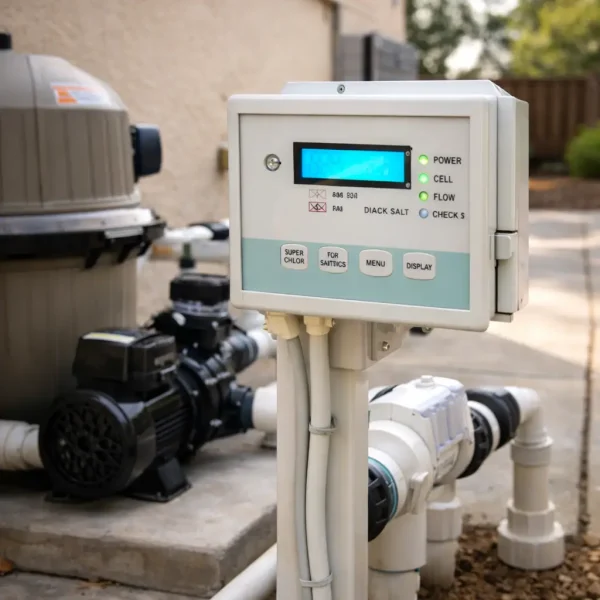
One local factor worth noting: power surges during Rocklin’s summer thunderstorms frequently damage control boards while leaving the salt cell completely intact. If your system stopped working after a storm, the board is the first place we check.
Before you spend money on a new salt cell, a quick professional test tells you exactly where you stand. Too many pool owners in Rocklin replace cells that only needed a good cleaning, and others keep cleaning cells that are already past the point of recovery.
We use two simple checks to give you a clear answer in minutes.
These two tests together take the guesswork out of the decision. You get a straight answer: clean it, or replace it.
In Rocklin, this testing matters more than in many other areas. The calcium-heavy municipal water that fills most pools in this region coats cell plates faster than soft-water areas. That buildup can make a cell look dead when it really just needs proper descaling. On the other hand, cells that have been running in high-calcium water for years without regular cleaning often have permanent damage hiding under the scale. Testing confirms which situation you are dealing with before you spend a dollar on parts.
If you own a saltwater pool in Rocklin, calcium is your biggest ongoing threat. Pool owners in Sunset West and the Park Drive area deal with this more than most because the local tap water carries elevated calcium hardness levels right out of the faucet. Every time you top off your pool or do a partial refill during peak summer, you are adding more calcium to the water.
Here is how it damages your salt cell.
As pool water passes through the cell, an electrical charge converts dissolved salt into chlorine. That same electrical charge attracts calcium and other dissolved minerals to the surface of the metal plates. Over time, a white chalky layer of scale forms on the plates and acts like insulation. The thicker the scale gets, the harder the cell has to work to push chlorine through. Output drops, energy consumption rises, and the plates wear out faster than they should.
Left unchecked, the buildup becomes permanent. Calcium that sits on the plates through an entire summer season can bond to the metal at a molecular level. At that point, even a strong acid soak will not fully restore the surface. The cell loses efficiency for good, and replacement becomes the only option.
The Placer County Water Agency supplies most of the municipal water in Rocklin, and local hardness levels are consistently higher than what most saltwater system manufacturers assume in their maintenance guidelines. That means the recommended cleaning schedule printed in your owner’s manual may not be frequent enough for this area.
A proper cleaning schedule built around Rocklin’s actual water conditions keeps scale from reaching the point of no return. We cover exactly how often to clean in the next section.
When testing confirms your salt cell or chlorinator is beyond repair, the priority is getting your pool back to producing chlorine as fast as possible. Every day without a working system means more manual chlorine dosing, more water chemistry swings, and a higher risk of algae taking hold.
We stock the most common cell and chlorinator models used in Rocklin homes and can complete most replacements in a single visit. The process is straightforward:
Matching the replacement to your specific setup matters. A cell that is too small for your pool volume will run at maximum output constantly, which shortens its lifespan. A cell that is oversized costs more upfront but runs at a lower percentage, reducing wear on the plates and lasting significantly longer. We walk you through both options so you can make the choice that fits your budget and goals.
During June through September, Rocklin pool companies see the highest demand for salt cell replacements. Systems that held on through the cooler months often fail once summer heat pushes them to full capacity. If your cell is aging or your chlorine output has been dropping, scheduling a diagnostic early in the season helps you avoid a longer wait during peak months.
The single best thing you can do for your saltwater system is keep the cell clean. A simple muriatic acid soak every three to four months dissolves calcium scale before it has a chance to bond permanently to the plates. This one habit alone can double the working life of your salt cell.
The cleaning process is not complicated.
For Rocklin pool owners, the standard manufacturer cleaning schedule is not frequent enough. Most owner’s manuals recommend cleaning every six months or only when the system alerts you. That timeline assumes softer water than what comes out of Rocklin’s taps. In this area, cells need attention every three to four months during pool season. Homes filled with local municipal water during peak summer may need cleaning every two to three months to stay ahead of the buildup.
Skipping even one summer cleaning can make a noticeable difference. Scale that accumulates through July and August in Rocklin’s heat hardens quickly on the plates. By the time you notice output dropping in September, the damage may already be reducing your cell’s remaining lifespan.
A consistent cleaning routine keeps your plates in good shape, your chlorine output steady, and your replacement costs years down the road instead of months. If you would rather have a professional handle it, we include cell inspections and cleaning recommendations as part of our regular service visits.
Whether your salt cell needs replacing or just cleaning in Rocklin depends on how the plates respond to an acid soak. Inspect the plates for heavy white buildup and run a cleaning cycle first. If chlorine output does not improve after a proper acid soak, a professional cell test measures plate condition and confirms whether the cell is worn out or still has life left.
A pool chlorinator can sometimes be repaired if the issue is a replaceable flow sensor or blown fuse. These are minor parts that restore function quickly. If the control board is fried, full unit replacement is usually more cost-effective than attempting a board-level repair.
A salt cell stops working early most often because of calcium scale buildup, incorrect salt levels, or running the cell at maximum output for extended periods. Rocklin’s hard municipal water speeds up scale-related failure compared to areas with softer water, which means local cells face shorter intervals between required cleanings.
A saltwater system repair in Rocklin can typically be scheduled within the same week. Diagnostic visits identify the failed component on site, and salt cell or chlorinator replacements are completed same day in most cases.
Commercial Pool Maintenance
Pool Filter Repair
Swimming Pool Inspection
Pool Pump Replacement
Swimming Pool Heater Repair
Pump Repairs & Installation
Pool Motor Repair
Swimming Pool Electrical Repair
Pool Automation System Repair
Pool Light Repair
Swimming Pool Auto Water Fill Repair
Heat Pump Repair
Pool System Diagnostics
Swimming Pool Equipment Repair
Pool Plumbing Repair
Serving: Rocklin · Roseville · Lincoln · Granite Bay · Loomis · Penryn · Newcastle · Auburn · Citrus Heights · Folsom · Orangevale · Fair Oaks · Carmichael
Schedule your Rocklin saltwater system repair before low chlorine becomes a bigger problem.