


In Rocklin, pool lights fail more often than most owners expect. Burned-out bulbs, LED malfunctions, fixture leaks, and wiring faults all leave pools dark and unsafe after sunset. Whether the light flickers once and dies or never turns on at all, the problem rarely fixes itself.
Cool Pools provides professional pool light repair for Rocklin homeowners with same-week scheduling available for most jobs. Our technicians diagnose the issue, complete the repair, and test the light before leaving. If your pool light is out, we can help.
Yes. A trained technician can repair most pool lights on site in a single visit. Repairs cover burned-out bulbs, corroded fixtures, faulty wiring, and broken seals.
Common pool light repairs include:
Most jobs in Rocklin are completed without draining the pool. The technician pulls the fixture to the deck using the cord stored in the niche, completes the repair, and tests the light before leaving.
A working pool light does the same thing every time you flip the switch. It turns on, stays bright, and holds steady. When something changes, the fixture is telling you there is a problem.
Flickering is one of the earliest signs. The light may flash on and off or pulse at random. This usually points to a loose connection, a failing bulb, or water starting to reach the wiring inside the fixture housing.
Dimming comes next. If the light looks weaker than it used to, the bulb may be near the end of its life. LED modules can also dim when the driver board starts to fail.
Total blackout is the most obvious signal. The light simply does not turn on. Before assuming the worst, check your GFCI breaker. If it trips as soon as you reset it, the fixture likely has a wiring fault or a broken seal letting moisture in.
Water inside the lens is a serious warning. If you can see condensation or a foggy look behind the glass, water has entered the fixture housing. Left alone, this leads to corrosion, short circuits, and a much bigger repair.
Catching these signs early prevents water from reaching the fixture niche, which causes more damage and a higher repair cost. In neighborhoods like Whitney Oaks and Stanford Ranch, heavy night swimming runs from May through October. A working pool light is not just a convenience during those months. It is a safety priority for every evening swim.
One of the first concerns Rocklin pool owners raise is whether the pool needs to be drained for a light repair. In most cases, the answer is no.
Pool lights are designed to be serviced from the deck. Each fixture sits inside a niche built into the pool wall, with extra cord coiled behind it. A technician removes the single screw holding the fixture in place, then pulls the light up onto the deck using that stored cord. The bulb, gasket, and lens are all accessible without lowering the water level.
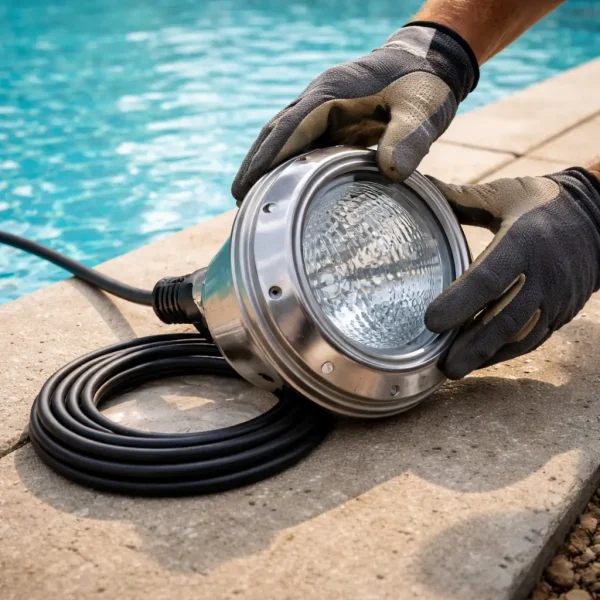
This matters in Rocklin for a practical reason. The area’s granite-heavy soil slows both drainage and refill. Emptying a pool here takes longer than in areas with sandy or loamy ground, and refilling adds time and cost on top of the repair itself. Skipping the drain saves real money and gets your light working again faster.
Most bulb replacements, LED module swaps, and gasket repairs are completed right on the deck in a single visit. The only situations that may call for lowering water are rare cases involving the niche housing itself or a fixture that has been sealed in place by calcium buildup over many years.
If your pool light is out, do not assume you need to drain the pool first. A qualified technician can assess the fixture and handle the repair with the pool full.
Pool lights run on electricity inches from water. That combination leaves no room for shortcuts or guesswork. Even a small wiring mistake can create a serious shock hazard for anyone in or near the pool.
California requires proper bonding and grounding on all pool electrical systems. These standards exist because pool water is a conductor. Every metal component around the pool, from the light fixture to the handrails to the pump motor, must be bonded together and grounded to prevent stray voltage from reaching swimmers. The National Electrical Code (NEC) Article 680 covers these requirements in detail and applies to every pool light installation and repair in the state.
Placer County inspectors enforce these standards. Homes in Sunset West and Clover Valley often have older wiring that was installed under previous code versions. A licensed professional knows how to evaluate what is already in place and bring the repair up to current requirements.
Here is what a qualified technician checks during every pool light repair:
DIY pool light repair is not worth the risk. The cost of hiring a licensed professional is small compared to the safety it protects. If your pool light needs work, have it done right.
Knowing what to expect makes it easier to schedule the appointment and plan your day. Most pool light repairs in Rocklin take one to two hours from start to finish.
Arrival and assessment. The technician starts at the equipment pad and checks the GFCI breaker, timer settings, and any automation controls tied to the light circuit. This rules out simple causes like a tripped breaker or a bad relay before anyone touches the fixture.
Fixture removal. The single mounting screw is removed and the fixture is pulled up onto the deck using the cord stored in the niche. The technician inspects the bulb or LED module, the lens gasket, the cord seal, and the housing for signs of water intrusion or corrosion.
Diagnosis and repair. Once the problem is identified, the technician explains what failed and what it takes to fix it. Common repairs include replacing a burned-out bulb, swapping an LED driver board, installing a new lens gasket, or repairing a damaged cord connection at the junction box. Parts for the most common fixture types used in Rocklin pools are carried on the truck.
Reinstallation and testing. After the repair, the fixture goes back into the niche and the mounting screw is secured. The technician powers the light on and confirms it holds steady. For color-changing LEDs, a full color cycle is run to verify every mode works.
Our technicians work with the pool builds most common in Rocklin, including Pebble Tec, standard plaster, and vinyl finishes. That familiarity with local fixture types and niche configurations helps the job go smoothly and keeps the visit on schedule.
Before the technician leaves, you should see a complete check that proves the repair holds up. Asking for this is reasonable, and a good technician will walk through it without being asked.
The first test is the GFCI breaker. The technician trips it manually and resets it to confirm it responds correctly. A GFCI that does not trip on demand is a safety problem on its own, separate from the light repair. This test takes seconds and should never be skipped.
Next is the seal inspection. The fixture should sit flush in the niche with no visible gaps around the lens ring. If a new gasket was installed, the technician confirms it is seated evenly with no pinched or rolled edges. A bad seal lets water creep into the housing over time, which brings the same problem back months later.
For color-changing LED lights, the technician runs a full cycle through every color and mode. A module that works on white but skips blue or green has a partial failure that will get worse. Cycling through every setting catches this before the visit ends.
You can also do a simple check on your own that evening. Wait until dusk and turn the light on from inside the house. Watch it for ten to fifteen minutes. It should hold steady with no flicker, no dimming, and no unexpected shutoff. Summer evenings in Rocklin stay warm enough through the main pool season to do this comfortably from the patio.
If anything looks off during that evening check, call back right away. A quick follow-up visit is much easier than starting the diagnosis over from scratch.
Most pool light failures do not happen overnight. They build slowly over months or even years. A few simple checks at the right time of year catch problems before the light goes out completely.
Start each pool season with a visual inspection of the fixture. Look through the water at the lens. If you see fog, condensation, or discoloration behind the glass, moisture has started to get in. That means the gasket is wearing and needs attention before water reaches the wiring.
Test your GFCI breaker once a month during swim season. Press the test button, confirm it trips, then reset it. A breaker that does not trip needs to be replaced. This is a safety check that takes less than a minute and protects everyone in the pool.
Check the area around the fixture niche for cracks in the plaster or Pebble Tec. Shifts in the pool shell can pull the niche slightly out of alignment, which stresses the gasket seal. Homes near Quarry Park and along the older Sierra College corridor see this more often due to the age of the pools in those areas.
Rocklin’s climate plays a direct role in how fast fixture components wear out. Hot summers push daytime temperatures above 100 degrees. Cool winter nights drop into the 30s. That cycle of expansion and contraction works against rubber gaskets and cord seals season after season. Annual inspection by a qualified technician catches seal wear, cord damage, and voltage irregularities before they turn into a full failure.
A pool light that gets a quick seasonal check lasts longer and fails less. The small effort up front saves a bigger repair bill later.
LED pool lights typically last 7 to 15 years before they need replacement. The exact lifespan depends on how often the light runs and the conditions around it. Rocklin’s high summer heat and constant chemical exposure can shorten that range. Dimming or partial color loss on a color-changing LED usually means the module is reaching the end of its life.
No, it is not safe to swim with a broken pool light. A cracked lens or failing seal can allow water to reach live wiring inside the fixture housing. Even if the light simply does not turn on, the cause could be a wiring fault that creates a shock risk in the water. Book a repair before anyone uses the pool.
Before calling for pool light repair in Rocklin, start by checking the GFCI breaker on the light circuit. Locate the breaker, press the reset button, and see if the light comes on. If the breaker trips again immediately, the fixture likely has a wiring fault or a seal failure that needs professional attention. Also check your pool automation panel or timer to make sure the light circuit is set to run.
Commercial Pool Maintenance
Pool Filter Repair
Swimming Pool Inspection
Pool Pump Replacement
Swimming Pool Heater Repair
Pump Repairs & Installation
Pool Motor Repair
Swimming Pool Electrical Repair
Pool Automation System Repair
Pool Plumbing Repair
Swimming Pool Auto Water Fill Repair
Heat Pump Repair
Pool System Diagnostics
Swimming Pool Equipment Repair
Saltwater System Repair
Serving: Rocklin · Roseville · Lincoln · Granite Bay · Loomis · Penryn · Newcastle · Auburn · Citrus Heights · Folsom · Orangevale · Fair Oaks · Carmichael
Schedule your Rocklin pool light repair before your next evening swim.