


Rocklin’s hard water and triple-digit summer heat shift pool chemistry fast. Without regular testing, your water can turn cloudy, irritate skin, or damage equipment before you notice a problem.
Cool Pools, Inc. provides professional pool water testing for residential and commercial pools across Rocklin. We test for the full range of chemical and mineral levels that affect water safety and equipment life. Same-week testing is available with a clear treatment plan after every visit.
As a trusted local swimming pool repair service with over 23 years of experience, we pair every water test with honest next steps so you know exactly where your pool stands.
Pool water in Rocklin should be tested at least once per week during summer and every two weeks in cooler months. High temperatures and calcium-heavy tap water shift pH and alkalinity faster than pools in mild climates. Test more often after heavy pool use, refills, or rain.
Most pool owners test once a month or less. In Rocklin, that is not enough.
Summer temperatures regularly climb above 100°F here. That kind of heat burns through chlorine fast. A pool that tested fine on Monday can be low on sanitizer by Wednesday. Without enough chlorine, algae and bacteria start growing quickly.
Pools in Whitney Ranch and Stanford Ranch with full sun exposure lose sanitizer even faster. Direct sunlight breaks down chlorine throughout the day, leaving your water unprotected during the hottest hours.
Testing on a regular schedule prevents three common problems:
A weekly test during swim season catches small shifts before they become big headaches. In the cooler months, biweekly testing keeps your water stable and your equipment protected.
The cost of a simple water test is far less than the cost of a green pool cleanup or a corroded heater.
Home test strips check the basics. They give you a rough reading on chlorine and pH. But that is only part of the picture.
Professional pool water testing measures levels that strips cannot detect. These include cyanuric acid, total dissolved solids (TDS), and metals like copper and iron. In Rocklin, where mineral-rich tap water raises calcium hardness levels quickly, these hidden readings matter more than most pool owners realize.
Here is what professional testing covers that home kits do not:
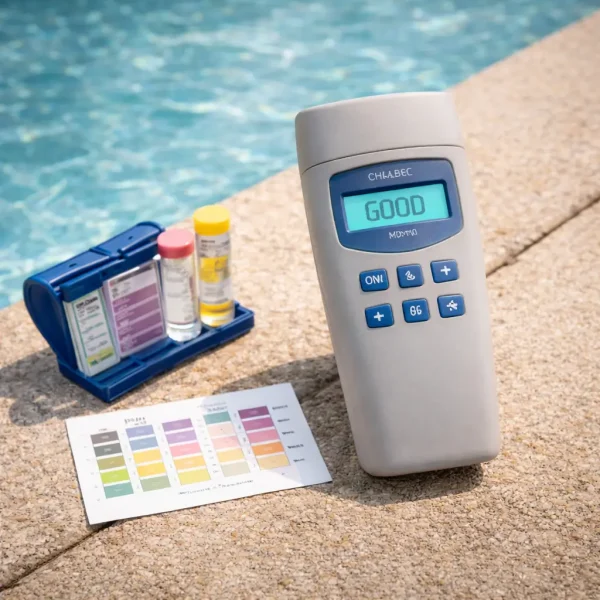
According to the CDC’s healthy swimming guidelines, proper water chemistry is one of the most effective ways to prevent recreational water illness. Professional testing gives you the full data to keep your pool safe and your equipment running.
A strip might tell you chlorine looks fine. A professional test tells you why your water still looks off.
Getting your pool tested is the first step. Understanding what the numbers mean is what keeps your water clear and your equipment safe.
Every professional water test measures several key readings. Here is what each one tells you and what to do when it falls outside the ideal range.
pH (7.2 to 7.6) pH measures how acidic or basic your water is. When pH runs high, chlorine loses its cleaning power. When it drops too low, water becomes corrosive and can irritate skin and eyes. Most adjustments are simple and take effect within a few hours.
Total Alkalinity (80 to 120 ppm) Alkalinity acts as a buffer for pH. When alkalinity is low, pH swings up and down without warning. Keeping alkalinity in range makes every other chemical in your pool work better.
Free Chlorine (1.0 to 3.0 ppm) This is the active chlorine available to sanitize your water. In Rocklin’s summer heat, free chlorine drops fast. If readings fall below 1.0 ppm, bacteria and algae can take hold within a day.
Calcium Hardness (200 to 400 ppm) Pools in Sunset Whitney and Clover Valley often show elevated calcium due to local water supply conditions. High calcium causes white scale on tile and inside equipment. Low calcium makes water aggressive, which wears down pool surfaces over time.
Cyanuric Acid (30 to 50 ppm) CYA shields chlorine from UV breakdown. Too little and chlorine burns off in hours. Too much and chlorine stops working even when levels look normal on paper.
Total Dissolved Solids TDS measures the total concentration of dissolved minerals in your water. When TDS climbs too high, chemicals become less effective and water looks dull. A drain and refill is often the only fix.
Each reading connects to the others. One number out of range can throw off the rest. That is why a full professional test gives you a complete picture instead of a partial guess.
Rocklin sits in the Sierra Nevada foothills where two things work against your pool chemistry every day: hard water and extreme heat.
Water from Placer County sources carries higher mineral content than many other parts of Northern California. That means your pool starts with elevated calcium and dissolved minerals every time you top it off or refill after a drain. Over weeks and months, those minerals build up inside your plumbing, coat your heater elements, and leave white scale along the waterline.
Then the heat compounds the problem. When summer air temperatures push past 100°F, pool water warms quickly. Warm water accelerates chemical reactions. Chlorine breaks down faster. pH drifts higher. Algae spores that would stay dormant in cooler water begin multiplying in hours instead of days.
Foothill neighborhoods deal with a few extra factors that pools closer to the valley floor do not face:
The Placer County Water Agency reports mineral content data for local water sources, and the readings confirm what pool owners in Rocklin already see at the waterline. Calcium and mineral levels here run higher than state averages.
None of this means your pool cannot stay balanced. It means the margin for error is smaller. A pool in a mild climate with soft water might hold steady for two weeks between tests. A pool in Rocklin can drift out of range in a matter of days.
Regular professional testing accounts for these local conditions. It gives you accurate data so adjustments happen before scale, corrosion, or algae take over.
A water test takes minutes. The problems that develop without one take weeks and hundreds of dollars to fix.
When pool chemistry drifts unchecked, the damage happens slowly. You might not see it right away. But inside your equipment and along your pool surfaces, unbalanced water is already doing harm.
Low pH and alkalinity turn water corrosive. Corrosive water eats away at metal components inside your pump, heater, and filter housing. Copper heat exchangers are especially vulnerable. By the time a heater stops working, the internal damage is often too far gone for a simple repair.
High calcium builds scale inside plumbing and equipment. Scale narrows pipe openings, reduces water flow, and forces your pump to work harder. That extra strain shortens pump life and drives up energy costs. Heater elements coated in scale lose efficiency and eventually fail.
Chlorine that stays too low invites algae. A mild algae bloom might only need a shock treatment. A full green pool cleanup requires draining, heavy chemical treatment, and multiple service visits. What a weekly test could have caught for a few dollars turns into a repair bill that reaches several hundred.
Rocklin’s extreme summer heat accelerates all of these problems. Corrosion moves faster in warm water. Scale forms quicker when minerals concentrate under high evaporation. Algae doubles in volume in less than a day when sanitizer drops and water temperature climbs.
Homes near Spring View and Park Drive see heavy seasonal use during summer months. More swimmers mean more organic load in the water, which burns through chlorine even faster. Without regular testing, these pools fall out of balance before the next service visit.
A simple water test is the most affordable form of pool protection. It catches small imbalances early so your equipment lasts longer and your water stays safe to swim in.
Your pool water is always changing. Testing keeps you one step ahead.
Cool Pools provides full professional water testing across every Rocklin neighborhood, including Whitney Oaks, Stanford Ranch, and Twelve Bridges. Every test covers the complete range of chemical and mineral levels your pool needs to stay balanced and safe.
Here is how it works:
If your water needs treatment, we handle it on the spot or schedule a follow-up so nothing sits unaddressed. If your chemistry looks good, we tell you that too.
Testing is the fastest way to protect your equipment, prevent algae, and keep your pool ready for your family. One visit gives you the full picture.
Request your pool water test today and take the guesswork out of pool care.
Signs of poor pool water quality include cloudy water, a green tint, strong chlorine smell, skin or eye irritation, and visible scale on tile or equipment edges. Any of these signals mean your water chemistry has drifted and should be tested as soon as possible.
Pool water test results from a professional on-site visit are available within minutes. There is no waiting for a lab. Your technician reads the results during the visit and walks you through what each number means and what action to take.
Pool water testing from Cool Pools includes a clear treatment plan based on your results. If your water needs adjustment, your technician explains what is needed and why before any work begins. Simple corrections can often be made the same visit.
Serving: Rocklin · Roseville · Lincoln · Granite Bay · Loomis · Penryn · Newcastle · Auburn · Citrus Heights · Folsom · Orangevale · Fair Oaks · Carmichael
Schedule your Rocklin pool water test before bad chemistry damages your equipment.