


Saltwater pools in Rocklin need consistent, expert care to stay clear and safe all year. From salt cell cleaning and salt level testing to seasonal maintenance and system checks, Cool Pools keeps your saltwater system running the way it should. We offer flexible weekly and monthly service visits so your pool gets attention when it needs it. As a trusted local swimming pool repair service with over 23 years of experience, we help Rocklin pool owners spend less time worrying and more time swimming.
Saltwater pool maintenance includes regular salt level testing, cell inspection, and water chemistry balancing. In Rocklin, hard water and summer heat increase the demand on salt chlorinators. Professional service keeps equipment running and water safe.
A lot of pool owners believe saltwater pools take care of themselves. That is not how it works. Your salt chlorinator produces chlorine, but it still depends on balanced water chemistry, clean filters, and a healthy salt cell to do its job.
In Rocklin, the demand on your system is even higher. Summer temperatures regularly hit 100°F and above. That kind of heat increases chlorine burn-off and speeds up evaporation. When water levels drop, salt concentration shifts. When chlorine demand spikes, your cell works harder and wears faster.
Without regular service, small imbalances turn into bigger problems quickly:
Routine saltwater pool service catches these issues early. We test salt levels, inspect equipment, and adjust chemistry on a set schedule so your pool stays swim-ready and your system lasts longer.
When your salt level drops too low, the chlorinator cannot produce enough chlorine to keep your water clear. You might notice hazy water, a “check salt” light on your control panel, or algae forming along the walls. These are signs your system is struggling.
The bigger risk is what you do not see right away. A chlorinator running on low salt works harder than it should. Over time, that extra strain shortens the life of your salt cell and can damage the control board. What starts as a minor imbalance can turn into an expensive repair.
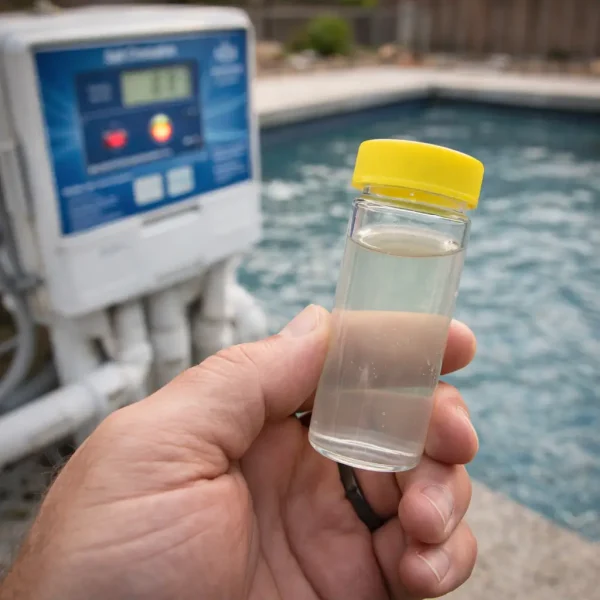
In the Sacramento Valley, heavy spring rain is one of the most common causes of sudden salt loss. A single storm can dilute your pool’s salt concentration well below the chlorinator’s operating range. Pools in neighborhoods like Whitney Ranch and Stanford Ranch with older plaster surfaces lose salt even faster through surface absorption.
Here is what we check during a salt level service visit:
Getting ahead of low salt levels protects your equipment and keeps your water clean between visits.
Your salt cell is the most important part of your saltwater system. It is also the most expensive to replace. A quality salt cell should last 5 to 7 years, but that lifespan depends on how well it is maintained.
Over time, calcium deposits build up on the cell plates. That scale blocks the flow of electricity through the cell and reduces chlorine output. If left unchecked, the buildup hardens and becomes much more difficult to remove without damaging the plates.
Rocklin’s water is notoriously hard. The high calcium content coming from Sierra foothills sources causes scale to form faster here than in areas with softer water. That means salt cells in Rocklin need cleaning more often to stay efficient.
We clean salt cells by hand using a controlled acid wash process that dissolves calcium without corroding the titanium plates. It is a careful balance. Too strong and you shorten the cell’s life. Too weak and the scale stays. Our technicians know exactly what concentration to use and how long to soak based on the level of buildup.
What professional cleaning restores:
Regular cell cleaning is one of the simplest ways to protect your investment and avoid early replacement. According to the U.S. Department of Energy, keeping pool equipment properly maintained also reduces overall energy consumption, which saves you money beyond just extending equipment life.
If you have been testing your own salt levels and wondering whether that is enough, it probably is not. A salt test strip tells you one number. A trained technician sees the full picture.
Placer County water carries a high mineral load. That mineral content does not just affect your salt cell. It accelerates wear on o-rings, flow sensors, and internal fittings throughout the chlorinator system. Neighborhoods like Sunset West and Clover Valley deal with calcium scaling year-round, not just during the hot months.
What DIY testing misses that a professional visit catches:
These are the kinds of problems that do not show up on a test strip. By the time you notice symptoms in the water, the damage is already underway.
Professional saltwater pool service in Rocklin means someone is watching your entire system, not just one reading. We inspect the cell, check the control board, test water chemistry, and look at every connection point that hard water puts at risk.
The difference between DIY testing and professional maintenance is simple. One tells you where your salt level is today. The other tells you whether your system will still be running next season.
Your salt cell produces a steady supply of chlorine, but it has limits. Over weeks of regular use, chloramines and organic compounds build up faster than the cell can break them down. That is when the water starts to look dull, smell off, or feel irritating on your skin.
Periodic superchlorination, commonly called shocking, resets your water chemistry. It burns off the buildup that daily chlorine production cannot handle on its own.
In Rocklin, the need for shocking is higher than in most areas. The swim season stretches six months or longer, from April through October and sometimes beyond. That is a lot of sunscreen, body oils, and organic material entering the water week after week.
Spring brings another challenge. Oak pollen drops heavy across Rocklin neighborhoods, coating pool surfaces and feeding algae growth. Leaf debris from the surrounding granite-studded landscape adds to the organic load. Without periodic shocking, that buildup overwhelms your chlorinator.
A smart shocking schedule for Rocklin saltwater pools looks like this:
We handle shocking as part of your regular service schedule. You do not need to buy chemicals, guess dosages, or figure out timing. We monitor your water and shock when the conditions call for it, so your pool stays clear from the first swim of spring to the last one in fall.
A saltwater system has more moving parts than most pool owners realize. The cell, control board, flow sensor, plumbing connections, and power supply all work together. When one component starts to fail, it puts stress on everything else.
An annual inspection gives us a chance to look at every part of your system before a small issue turns into a breakdown. We check cell output, test the control board for error patterns, inspect seals and fittings, and measure water flow through the plumbing.
In Rocklin, two local factors make yearly inspections especially valuable.
Ground movement and clay soil. Much of Rocklin sits on clay-heavy soil that expands and contracts with the seasons. That shifting puts pressure on underground plumbing connections over time. A loose fitting or stressed joint may not leak today, but one more freeze-thaw cycle could push it past the breaking point.
Winter temperature swings. Rocklin winters bring cold snaps that dip below freezing, followed by mild afternoons. That back-and-forth is hard on seals, o-rings, and exposed equipment. A cell left in a housing with a worn gasket during a freeze event can crack and fail.
What we cover in a full annual saltwater pool inspection:
One visit a year gives you a clear picture of where your system stands. It costs a fraction of what an emergency repair would, and it keeps your pool running through every season Rocklin throws at it.
Yes, saltwater pools still require manual chemical balancing. The salt cell produces chlorine, but pH, alkalinity, stabilizer, and calcium hardness levels all need regular testing and adjustment by a technician. Relying on the cell alone leads to imbalanced water that can damage surfaces and irritate skin.
Salt cell replacement in Rocklin typically ranges from $500 to $1,200 depending on the brand, model, and size of your pool. The cost includes the cell itself and professional installation. Investing in regular cell cleaning and maintenance helps you get the full 5 to 7 year lifespan from your current cell before replacement becomes necessary.
A saltwater pool still uses chlorine to sanitize the water. The difference is how the chlorine gets there. In a traditional chlorine pool, you add chlorine tablets or liquid manually. In a saltwater pool, a salt chlorinator converts dissolved salt into chlorine automatically. Saltwater pools tend to feel softer on skin and eyes, but they require specialized equipment maintenance that a standard chlorine pool does not.
Serving: Rocklin · Roseville · Lincoln · Granite Bay · Loomis · Penryn · Newcastle · Auburn · Citrus Heights · Folsom · Orangevale · Fair Oaks · Carmichael
Schedule your Rocklin saltwater pool service before low chlorine ruins your water.