


Hard water and triple-digit summers push pool chemistry out of range fast in Rocklin. When pH drifts or chlorine drops, your water stops being safe to swim in. Cool Pools provides professional pool chemical balancing for residential and commercial pools across Rocklin. Our team tests, diagnoses, and corrects your water chemistry so your pool stays clean and protected. Same-week service is available from a trusted local swimming pool repair team with over 23 years of experience.
Pool chemical balancing in Rocklin should happen every week during swim season, which runs from April through October. In winter, testing at least twice a month keeps water safe. The Sacramento Valley’s hard water and extreme summer heat speed up chlorine loss and calcium buildup, so Rocklin pools need more attention than national guidelines suggest.
A trained technician catches imbalances that test strips miss.
If your pool water looks hazy or has a green tint, something is off. Burning eyes, dry skin, and itchy ears after swimming are not normal. These symptoms usually point to one of three problems: low pH, depleted chlorine, or high alkalinity.
The cause is not always obvious. A pool can look mostly clear and still carry chemistry that irritates skin or allows bacteria to grow. That is why a fast, accurate diagnosis matters more than guessing which chemical to add.
Rocklin’s groundwater makes this worse. The granite-belt water supply in this area carries elevated calcium and mineral content. Those minerals shift pH faster than softer water sources found in other parts of the state. A pool that tested fine on Monday can drift out of range by Thursday, especially during hot stretches.
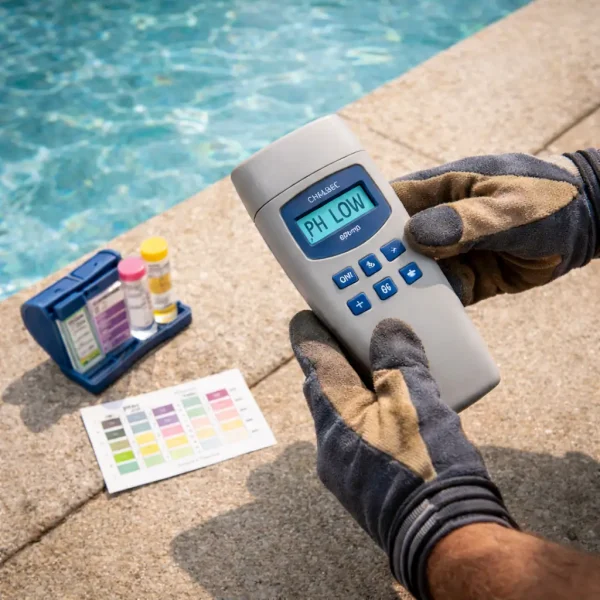
Our technicians use digital testing tools to pinpoint the exact imbalance. Instead of dumping in chemicals and hoping for the best, we identify the root cause and correct it. That saves you money on wasted product and gets your pool back to safe, swim-ready condition faster.
Unbalanced water does more than look bad. It quietly damages the equipment keeping your pool running. When pH runs too low, acidic water eats away at pump seals, heater cores, and metal fittings. When calcium climbs too high, scale builds up inside pipes and on heat exchangers. Both problems lead to repair bills that a simple weekly test could have prevented.
Families in Whitney Oaks and Stanford Ranch run their pools from early spring well into fall. That means eight or more months of chemical exposure, evaporation, and UV breakdown every year. Pools in cooler climates deal with half that wear. Here in Rocklin, the extended swim season puts more stress on your water and your equipment.
What weekly testing catches before it becomes a repair:
The CDC recommends testing pool water chemistry at least a few times per week to protect both swimmers and equipment. In a climate like Rocklin’s, professional weekly service is the most reliable way to stay ahead of problems.
We test, adjust, and document your water chemistry on every visit. If we spot early signs of equipment stress, we flag it before it turns into a breakdown. That is how consistent testing protects both your water and your wallet.
Many pool owners in Rocklin start by adding chlorine or adjusting pH. That feels like the right move, but it usually backfires. If your alkalinity is off, every other adjustment you make will drift back out of range within a day or two. You end up using more product, spending more money, and never getting stable results.
The correct order is simple:
Skipping this sequence is the number one reason DIY balancing fails. You are not doing anything wrong with the chemicals themselves. The order just matters more than most people realize.
Rocklin’s tap water makes alkalinity the most common first correction we perform. Neighborhoods like Sunset Whitney and Clover Valley receive water with high total dissolved solids. That mineral load pushes alkalinity high right out of the tap, which means freshly filled pools and top-off water both introduce the same problem. Our technicians check alkalinity on every visit and adjust it before moving to pH or sanitizer levels. That single step keeps the rest of your chemistry stable between service days.
Rocklin is not like most pool markets. The combination of Placer County’s mineral-heavy water and summer temperatures above 100 degrees creates conditions that burn through chlorine nearly twice as fast as coastal California pools. What works for a pool in San Diego or Santa Cruz will not hold up here.
Chlorine loss is the biggest summer frustration. UV radiation breaks down free chlorine throughout the day. Add extreme heat and high bather loads from kids home for summer, and a properly dosed pool on Monday morning can test dangerously low by Tuesday afternoon. Low stabilizer levels, also called cyanuric acid, make this even worse. Without enough stabilizer acting as a shield, sunlight destroys chlorine before it can do its job.
Calcium scale is the other side of the problem. Rocklin’s water arrives with elevated calcium hardness straight from the source. When that water heats up in July and August, calcium falls out of solution and coats tile lines, heat exchangers, and the inside of your plumbing. Left unchecked, scale restricts water flow and forces equipment to work harder.
Our technicians address these issues together, not one at a time. During summer service visits, we adjust:
This approach is built around how pools actually behave in Rocklin, not around generic chemical charts. That local knowledge is the difference between a pool that fights you all summer and one that stays clear with less effort.
A pool that looks clean can still be hiding problems. Water clarity tells you about filtration. It tells you very little about chemistry. pH can sit well below safe levels in water that sparkles. Cyanuric acid can climb dangerously high without changing how the water looks. Metals like copper and iron can dissolve invisibly until one day they leave brown or green stains across your plaster.
This is where strip tests fall short. Dip strips give rough estimates of two or three readings. They miss metals entirely. They struggle with cyanuric acid accuracy. And they cannot measure total dissolved solids, which affect how every other chemical behaves in your water.
Professional digital testing reads what strips cannot:
Older plaster pools in the Spring Creek and Park Drive neighborhoods are especially prone to hidden metal staining. Years of mineral-rich fill water leave trace metals embedded in the plaster surface. The water looks perfectly clear until a chemistry shift releases those metals and discolors the finish in a matter of days. By the time you see the stain, the damage is already done.
We run a full digital panel on every service visit. If readings show early signs of metal buildup or chemical drift, we correct it that same day. Catching what your eyes cannot see is one of the biggest advantages of professional pool chemical balancing.
Rocklin winters are mild compared to most of the country. Pools here rarely freeze. But that does not mean you can ignore your water from November through March. Fall oak leaf debris dumps tannins and phosphates into the water. Winter rain runoff carries dirt, pollen, and organic matter over pool edges. Both push pH and phosphate levels in the wrong direction while no one is watching.
Closing your pool the right way matters. Proper shutdown chemistry prevents algae from blooming during months of low circulation. It also protects plaster and equipment surfaces from staining caused by unbalanced water sitting idle. Skipping this step is how pool owners end up with a green, stained mess when spring arrives.
Opening your pool correctly saves just as much time and money. A pool that was closed with the right chemistry needs far less work to get swim-ready in spring. One that was left untreated may need days of filtration, multiple shock treatments, and a full drain before anyone can use it.
Our spring startup process includes:
We handle closing and opening in a single visit each season. Your pool stays protected during the months you are not using it and gets back to swim-ready condition fast when warm weather returns.
It is safe to swim after adding chemicals once the water has circulated for at least 30 minutes to an hour for standard treatments. After a shock treatment, wait at least eight hours or until chlorine levels drop below 5 parts per million. Running the pump during this time helps distribute chemicals evenly. A quick test before getting in confirms the water is ready.
Yes, you should balance your pool water after a pool party. Heavy bather loads introduce sunscreen, sweat, and oils that consume chlorine quickly. A party with six or more swimmers can drop sanitizer levels enough to allow bacteria growth overnight. Testing and adjusting after heavy use keeps your water safe between regular service visits.
Tap water in Rocklin will affect your pool chemistry every time you add it. Local water carries high calcium and elevated total dissolved solids that raise hardness and alkalinity levels. Even topping off after evaporation introduces enough minerals to shift your readings. A technician should test and adjust after any significant water addition.
Serving: Rocklin · Roseville · Lincoln · Granite Bay · Loomis · Penryn · Newcastle · Auburn · Citrus Heights · Folsom · Orangevale · Fair Oaks · Carmichael
Schedule your Rocklin pool chemical balancing before bad chemistry damages your equipment.